
Week commencing January 8th 2024
TradeDay Macro Matters
Macroeconomic / Geopolitical developments
- Stocks and Bonds Sell Off, partially Correcting November-December Gains
- US Fed Minutes Give Little Clarity on Rate Cut Timing
- PMI Data Stays Resilient
- US Employment Report and ADP Data Beat Expectations
- What's Ahead
Stocks and Bonds Sell Off, partially Correcting November-December Gains
The onset of 2024 brought an unexpected downturn for Wall Street, challenging investor optimism following a spirited holiday rally. Concerns over Federal Reserve policy and a hotter-than-expected jobs report triggered a substantial cross-asset sell-off, the most significant to start a year in over two decades.
The S&P 500, breaking a 10-week winning streak, and declines in Treasuries and corporate credit, marked a retreat from the exuberance of November and December. Investors, initially anticipating March interest-rate cuts, faced a reality check as enthusiasm waned and a sense of overconfidence prevailed.
Despite the cautionary tale of market fluctuations, particularly in rate-sensitive strategies, the sell-off emphasized the dangers of complacency. The decline, influenced by factors like Apple downgrades and corporate issuance, highlighted the need for a balanced approach in navigating evolving market dynamics.
US Fed Minutes Give Little Clarity on Rate Cut Timing
Looking into the recently unveiled Federal Reserve Minutes from the Dec. 12-13 meeting, it shows clear uncertainty among policymakers. Divided perspectives reveal concerns about extended high rates, fearing potential job market volatility, while others advocate for a sustained target rate. Richmond Fed President Tom Barkin, slated to join the Federal Open Market Committee, introduces a note of caution, acknowledging the possibility of a soft landing but emphasizing its non-inevitability.

Despite the Fed's decision to keep rates unchanged, the Minutes offer limited clarity on the initiation of rate cuts. While consensus leans towards eventual decreases, the aftermath of the swiftest rate increase in four decades leaves a cloud of uncertainty. Analysts anticipate rate cuts, but debates linger on timing and extent, leaving the Fed's pivot in a speculative realm. In this milieu, Barkin's warning about latent effects on a soft landing introduces a cautious tone, shaping expectations for the economy in 2024. The delicate juggling act continues, with the Fed meticulously weighing factors such as inflation, interest rates, and overall economic stability at the forefront of their considerations.
PMI Data Stays Resilient
In an unexpected turn, the UK's service sector showcased its vitality by experiencing its most rapid growth in six months, surpassing predictions. The S&P Global UK services PMI for December soared to 53.4, exceeding the expected 52.7 and painting a picture of robust expansion, concluding the year on a high note.
Simultaneously, the US services PMI for December, conducted by S&P Global, defied expectations with a reading of 51.4, slightly surpassing the forecasted 51.3. This extends the streak of expansion to the 11th consecutive month, reaching its zenith since July. The data hints at accelerated growth in the expansive services sector, countering a manufacturing downturn and indicating a modest upswing in the overall US economic landscape as the year concludes.
Conversely, the HCOB's Composite Purchasing Managers' Index (PMI) for the Eurozone, crafted by S&P Global, clung below the growth threshold for the seventh successive month. December's figure held at 47.6, slightly above the preliminary estimate of 47.0 and exceeding expectations. While signalling a persistent contraction, the services PMI showcased a modest improvement, hitting a five-month high at 48.8, up from November's 48.7. This resilient narrative unfolds as a testament to the varied economic trajectories across regions.
US Employment Report and ADP Data Beat Expectations
The U.S. labor market ended 2023 on a strong note, with the December jobs report exceeding expectations. Employers added 216,000 positions, surpassing the forecasted 170,000, while the unemployment rate remained stable at 3.7%. The report showcased notable improvements from November, with revisions revealing a downwardly revised payroll growth of 173,000.
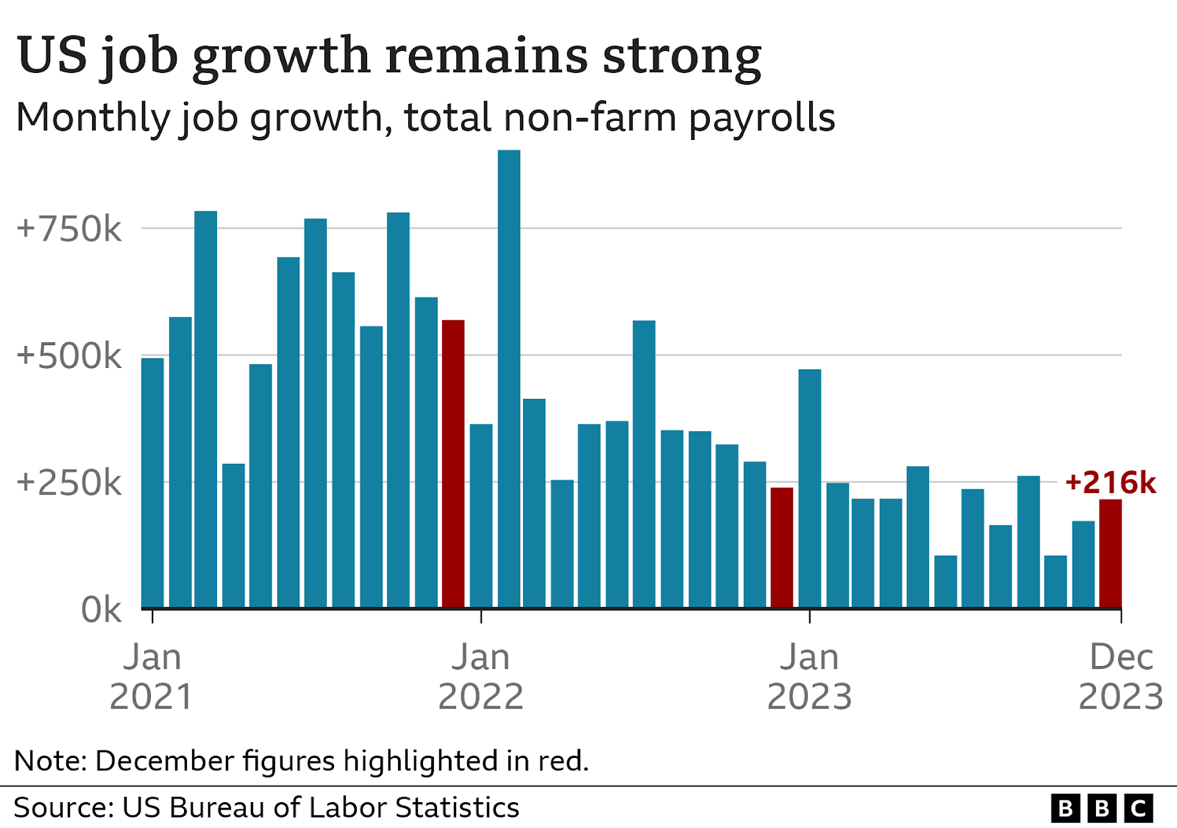
Despite positive hiring trends, the labor force participation rate decreased to 62.5%, reaching its lowest since February, shedding 676,000 participants monthly. The report, along with revisions, brought 2023 job gains to 2.7 million, with a monthly average of 225,000. Market reactions were mixed, with major averages fluctuating due to a lower-than-expected reading from the ISM services gauge. Treasury yields varied, particularly in longer durations.
The ADP employment report for December surpassed expectations, revealing a significant surge in US employment. Forecasts anticipated a modest rise of 115k jobs after November's 103k increase, but the actual data pleasantly surprised with a robust surge of 164k jobs.
The bulk of this employment boost originated from the services sector, contributing a substantial 155k jobs, while goods-producing jobs added a more modest 9k. Notably, the November figures underwent a slight revision, adjusting from 103k to 101k. This positive deviation in employment data paints a promising picture for the job market, showcasing resilience and potential strength in the US economy.
What's Ahead
Central Bank Watch: No central bank activity of note, but as usual watching for Fed speakers.
Macro Data Watch: US CPI on Thursday is the standout in a relatively light data week.
Date
Major Macro Data
01/08/2024
Eurozone Retail Sales (YoY & MoM) and Consumer Confidence
01/09/2024
Tokyo CPI; Australia Retail Sales; EU Unemployment Rate
01/10/2024
Australia CPI
01/11/2024
US CPI (YoY & MoM);
01/12/2024
China CPI (YoY & MoM) and PPI (MoM); UK GDP; US PPI (YoY & MoM); Michigan Consumer Sentiment Index
.jpg)