
Week commencing January 29th 2024
TradeDay Macro Matters
Macroeconomic / Geopolitical developments
- US Stock Averages Extend to Record Highs, Tech Leads
- Earnings Recap: Netflix and IBM Beat, Tesla Disappoints
- US Data: GDP Surprises Positively, PCE Below Expectations
- March Fed Rate Cut Expectations Fading
- ECB Gives No Hint On Rate Cuts
- PBoC’s Stimulus Encourages Bounce, After Stock Market Plunge
- What's Ahead
US Stock Averages Extend to Record Highs, Tech Leads
The S&P 500 continued its impressive run again hitting new all-time highs last week, fueled by robust U.S. economic growth in the fourth quarter. This comes off the back of 2023, where the S&P 500 and Nasdaq saw remarkable gains of 24% and 43%, respectively. Despite concerns about a potential recession after the Federal Reserve's interest rate hikes, the economy exceeded expectations with a 2.5% full-year growth rate, driven by strong consumer spending. This positive GDP surprise, coupled with the absence of problematic inflation, contributed to a bullish market sentiment.
Looking ahead, the fourth-quarter earnings for S&P 500 companies are projected to increase by 4.5% year-over-year, with notable gains expected in the communication services, information technology, and consumer discretionary sectors at 49%, 17%, and 23%, respectively. This positive momentum sets the stage for continued market optimism and potential growth in various sectors.
The upcoming quarterly results from tech giants Apple, Microsoft, Amazon, Alphabet, and Meta Platforms are eagerly awaited, offering insights into the sustainability of their high valuations.
This upward trajectory signals optimism about the economy, lower interest rates, and the prospects of companies tied to artificial intelligence.
Earnings Recap: Netflix and IBM Beat, Tesla Disappoints
Netflix
Netflix experienced a surge in its stock value, soaring nearly 11% following a robust fourth-quarter performance. The streaming giant exceeded expectations by adding 13.1 million subscribers, bringing its total paid subscriber count to a record 260.8 million. Netflix's quarterly net income reached $937.8 million, or $2.11 per share, compared to $55.3 million in the same period the previous year. The company reported revenue of $8.83 billion, surpassing Wall Street estimates.

As Netflix shifts its focus from subscriber growth to profitability, it raised its 2024 full-year operating margin forecast to 24%. Additionally, the company projects first-quarter 2024 earnings per share of $4.49, outpacing Wall Street's expected $4.10. Despite challenges in the streaming space, Netflix remains committed to investing in content and expanding its advertising-based plan, targeting long-term revenue growth opportunities.
IBM
IBM's stock surged over 9% after reporting a 4% increase in fourth-quarter revenue, driven by strong demand for AI products and hybrid cloud services. The stock's 24% rise over the past year marks a high for almost a decade. Earnings per share at $3.87 exceeded Wall Street's $3.76 estimate, and revenue of $17.4 billion beat the forecast of $17.29 billion. IBM expects its free cash flow to rise to about $12 billion in 2024. While the consulting business saw robust growth, security within its software segment contracted by 5%. The positive results reflect IBM's strategic focus on hybrid cloud and AI offerings, with generative AI applications gaining traction in coding productivity and operational efficiency.
Tesla
Tesla faced mixed results in its fourth-quarter report, revealing revenue of $25.1 billion and earnings of $0.71 per share. While the electric vehicle manufacturer added 484,000 vehicles in the final quarter of 2023, surpassing its own delivery expectations and marking a 38% year-over-year increase, it fell short of analyst predictions of $25.76 billion in revenue and $0.74 earnings per share.

Tesla's stock fell by 12% in after-hours trading as Elon Musk warned of a slower growth rate in 2024, lowering Tesla’s market capitalization reaching approximately $580 billion. Following Tesla's quarterly report on Wednesday, other electric car manufacturers also experienced declines, with Rivian Automotive losing 2.2% and Lucid Group dropping 6.7%.
Musk also unveiled plans for a new mass-market vehicle, Redwood, expected in mid-2025, priced at $25,000, aiming to compete with other global electric vehicle manufacturers. He further hinted at shipping Tesla's humanoid robot, Optimus, in the coming year, acknowledging the uncertainties. Tesla's focus on more affordable EV models and innovative projects demonstrates its commitment to navigating a dynamic and competitive market landscape.
US Data: GDP Surprises Positively, PCE Below Expectations
GDP
The United States witnessed an unexpected boost in its economic performance as the latest Gross Domestic Product (GDP) data revealed a robust annual growth rate of approximately 3.3% during the October to December period. This figure, measuring the total output of goods and services in the U.S., surpassed earlier predictions of 2%, although it marked a slight decline from the 4.9% recorded in the preceding quarter of July to September.
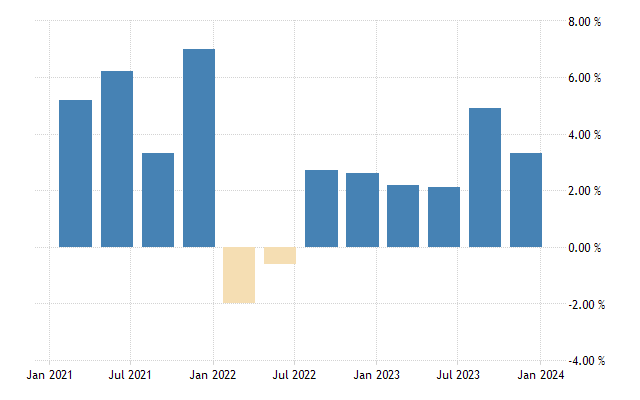
Annualized GDP Data
The overall GDP for the entire year exhibited positive momentum, reaching 2.5%, a notable increase from the 1.9% reported in 2022, as disclosed by the U.S. Department of Commerce. Consumer spending emerged as a pivotal driver behind this encouraging growth report, with spending from consumers rising at a substantial 2.8% annual rate in the final quarter of 2023. This positive economic surprise indicates the resilience of the U.S. economy, with consumer activity contributing significantly to the overall expansion, defying earlier expectations.
PCE
The Federal Reserve places particular emphasis on the Personal Consumption Expenditures (PCE) data, considering it a preferred measure of inflation compared to the Consumer Price Index (CPI). In the latest report from the US Bureau of Economic Analysis, the Core PCE inflation rate exhibited a moderation to 2.9% in December, coming in slightly below the anticipated 3% and marking a decrease from the 3.2% recorded in the preceding month.
Examining the broader picture, the overall PCE Price Index demonstrated a consistent yearly inflation rate of 2.6% in December, aligning with consensus expectations. The stability in these figures suggests a measured inflationary environment, providing insights into the economic landscape. Furthermore, on a monthly basis, both the PCE Price Index and the Core PCE Price Index displayed a 0.2% increase, in line with the consensus forecasts. These metrics offer a nuanced understanding of consumer spending trends and contribute to the Federal Reserve's assessment of the inflationary pressures within the US economy.
March Fed Rate Cut Expectations Fading
The prevailing sentiment among economists is that the U.S. Federal Reserve will delay any interest rate cuts until the second quarter, with June being deemed more likely than May. This shift comes in contrast to market expectations, which had initially priced in the possibility of a rate cut in March following remarks from Fed Chair Jerome Powell. However, recent data and statements from Fed officials have tempered these expectations.
The majority of economists, according to a Reuters poll, predict the Fed to maintain the Fed Funds rate at 5.25%-5.50% in January, with around 86 respondents foreseeing rate cuts in the next quarter, primarily in June (45%) and May (31%), while only 16% expect cuts in March.
Economists project a cautious Fed stance, closely monitoring the sustainability of recent inflation progress, and align with the Fed's dot plot predictions, projecting a year-end fed funds rate of 4.25%-4.50%, a more modest reduction in rates than current market expectations. While inflation, measured by the Personal Consumption Expenditures (PCE), is expected to average around the central bank's 2% target in the second half of 2024, some economists anticipate other inflation measures to remain above 2% until at least 2026 Despite an optimistic economic outlook, the expectation for the first rate cut has shifted towards June, reflecting a consensus that the U.S. economy, poised to avoid a recession, doesn't warrant early rate cuts.
ECB Gives No Hint On Rate Cuts
The European Central Bank (ECB) maintained its record-high interest rates and reiterated its commitment to combating inflation, dispelling speculation about an imminent policy easing. Despite market expectations of a potential pivot and projections of five rapid rate cuts, the ECB signaled no such shift in its latest statement.
The bank acknowledged inflation trends aligning with previous assessments but removed references to elevated domestic price pressures and strong labor cost growth. ECB Chief Christine Lagarde emphasized unanimity among governors that it's premature to discuss rate cuts, citing potential upside risks to inflation from geopolitical tensions and shipping disruptions. While financial markets anticipate rate cuts, the ECB's pushback underscores its cautious stance amid varying outlooks on economic growth and the effectiveness of past rate hikes.

The ECB expects household and government spending to drive recovery, but economic data portray a bleaker picture, with manufacturing in recession and services cooling, raising concerns about the timing and extent of potential rate cuts. The ECB's commitment to assessing incoming data for future decisions reflects its data-dependent approach, leaving uncertainty about the timing of any policy adjustments.
PBoC’s Stimulus Encourages Bounce, After Stock Market Plunge
China's central bank, the People’s Bank of China (PBoC), announced significant measures to stimulate the country's economy and bolster its stock markets. This comes as a response to China's $6 trillion stock market rout highlights the deepening pessimism about the country's economic outlook, posing a significant challenge for President Xi Jinping's government. The CSI 300 Index's recent 40% plunge over three years, primarily affecting retail investors and has prompted concerns.
Beginning on February 5, the PBoC will allow banks to hold smaller cash reserves, releasing 1 trillion yuan ($139.8 billion) in long-term capital through a 50 basis point cut in the reserve requirement ratio (RRR). This move, exceeding expectations, marks a potential shift in the PBoC's policy approach. The central bank, led by Governor Pan Gongsheng, aims to encourage lending to qualified developers, unveiling measures to support the real estate sector.

Despite concerns about a broader economic slowdown, the PBoC's decisive actions have sparked a positive market response, leading to a rebound in stock prices. Analysts suggest that these steps may indicate a willingness to adopt more accommodative policies, particularly with the Federal Reserve expected to ease later in the year. While the PBoC's efforts aim to stabilize markets, the fundamental turnaround in the economy requires time and sustained confidence. As uncertainties persist, including regulatory crackdowns and geopolitical tensions, investors remain cautious about the sustainability of the recovery.
What's Ahead
Central Bank Watch: A significant week for central banks with monetary policy decisions on Wednesday from the Fed and on Thursday from the Bank of England (BoE).
Macro Data Watch: Standouts this week are EU GDP (YoY, QoQ) on Tuesday, Japan Retail Trade and Sales and US ADP Employment on Wednesday, EU CPI (MoM, YoY) and US ISM Manufacturing PMI Thursday , US Employment and Michigan Consumer Sentiment Friday.
Earnings Watch: A huge week for earnings, with notable standouts being Microsoft, Alphabet, Boeing, Apple, Amazon, and Exxon Mobil
Date
Major Macro Data
01/29/2024
Nothing of note
01/30/2024
Japan Unemployment Rate; German and EU GDP (YoY, QoQ); US JOLTS Job Openings and Consumer Confidence
01/31/2024
China PMI; German Retail Sales, Unemployment and CPI; US ADP Employment; Fed Monetary Policy Statement, Decision and Press Conference
02/01/2024
EU CPI (MoM, YoY); EU Unemployment Rate; BoE Monetary Policy Decision, Report and Minutes; global Manufacturing PMI from S&P Global and US ISM Manufacturing PMI
02/02/2024
US Employment report; Michigan Consumer Sentiment
Date
Major Earnings Data
01/29/2024
Nothing of note
01/30/2024
Microsoft, Alphabet, Pfizer, Starbucks
01/31/2024
Mastercard, Qualcomm, Boeing
02/01/2024
Apple, Amazon, Merck & Co, Honeywell
02/02/2024
Exxon Mobil, AbbVie, Chevron
.jpg)