
Week commencing August 5th 2024
TradeDay Macro Matters
Macroeconomic / Geopolitical developments
- Global stocks sink on US recession fears
- US Jobs report sends hard landing warning
- Fed points to September cut
- Mixed Magnificent 7 earnings reports
- Bank of England cuts rates
- What's Ahead
Global stocks sink on US recession fears
Global stock markets plunged last week and again on Friday amid heightened fears of a potential U.S. recession following disappointing earnings, and a worrying jobs report. The U.S. economy added only 114,000 jobs in July, a significant drop from June's figures and far below expectations. Additionally, the unemployment rate rose to 4.3%, the highest level since October 2021. This report, coupled with weak manufacturing data released earlier in the week, sent major U.S. indices into a tailspin, with the Dow Jones Industrial Average closing down 1.5%, the S&P 500 dropping 1.8%, and the Nasdaq Composite falling 2.4%.
The negative sentiment extended beyond the U.S., with European markets also closing sharply lower. Amsterdam fell over 3%, Frankfurt dropped 2.3%, Paris slid 1.6%, and London decreased by 1.3%. Asian markets, which closed before the U.S. jobs data was released, were similarly affected, with Tokyo's Nikkei 225 plummeting 5.8%, its biggest drop since the onset of the COVID-19 pandemic. Hong Kong, Sydney, Seoul, and Taipei all experienced significant declines. Contributing to the global market turmoil were concerns over the Federal Reserve's potential interest rate cuts, following the weaker U.S. jobs data and the Bank of Japan's decision to hike rates. Investors are now speculating not just if the Fed will cut rates, but by how much, as they grapple with the implications of a cooling labor market and its impact on economic stability.
US Jobs report sends hard landing warning
A surprising rise in the U.S. unemployment rate last month has rattled financial markets and ignited concerns about a potential recession, though it might also be a false alarm. The latest jobs report revealed that nonfarm payrolls grew by just 114,000 in July, down from 179,000 in June, and the unemployment rate increased to 4.3%, the highest since October 2021. This data coincides with other indicators of economic cooling amid high prices and elevated interest rates, such as a survey showing weakened manufacturing activity in July. Additionally, Hurricane Beryl's impact on Texas during the job data compilation week could have restrained job gains.
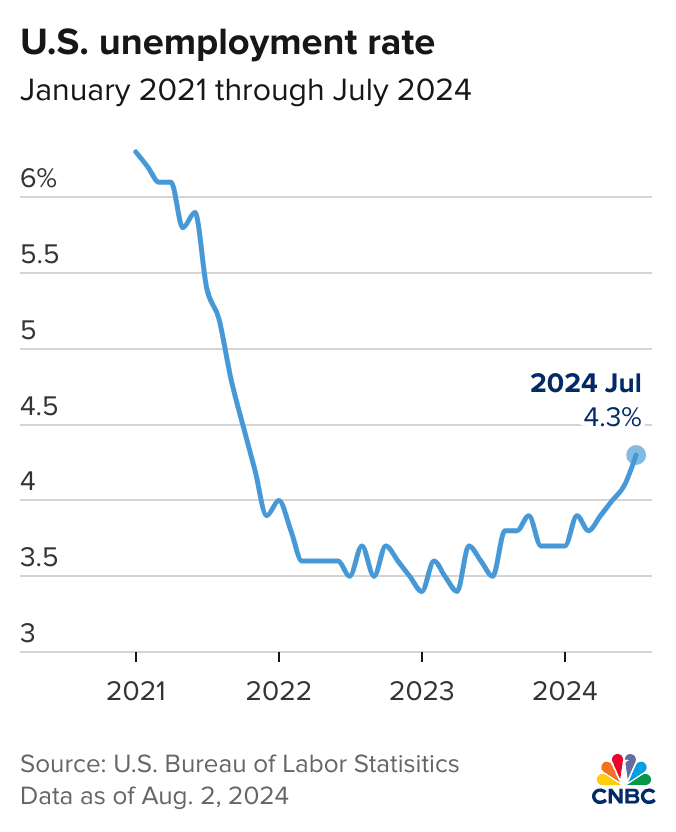
The uptick in unemployment and slowdown in job growth have raised alarms about the U.S. labor market's stability. Indeed Hiring Lab's Economic Research Director for North America, Nick Bunker, warned that the soft landing in the labor market is in jeopardy. A notable factor in July’s higher unemployment rate was an increase in "job loser unemployment," or temporarily laid-off workers, particularly in the manufacturing sector. These workers, although currently unemployed, retain a higher likelihood of rehiring within six months compared to other unemployed individuals.
The post-pandemic hiring surge appears to be waning, making job hunting more challenging across nearly every industry. As the unemployment rate rose to 4.3%, up from 3.5% a year ago, the number of unemployed Americans reached over 7.1 million, marking an increase of more than 1 million from last summer. Those without college degrees have been particularly affected, highlighting the growing difficulties in securing employment amidst economic uncertainties.
Fed points to September cut
Federal Reserve Chair Jerome Powell indicated on Wednesday that interest rates could be cut as soon as September if the U.S. economy follows the expected path, signaling a potential end to the central bank's prolonged battle against inflation amidst the presidential election campaign. The Fed concluded its latest two-day policy meeting by holding its benchmark interest rate steady in the 5.25%-5.50% range, maintaining this level for a year. However, the Fed's statement softened its language on inflation and balanced the risks to employment and rising prices, thereby opening the door for future rate cuts.
The likelihood of a double rate cut in September has increased significantly, with the CME FedWatch Tool showing a 71.5% chance of a 50 basis point cut at the upcoming Federal Open Market Committee meeting, a substantial rise from just 11.5% a week ago. This shift comes as market concerns pivot towards economic growth. While the odds of a 25 basis point cut have decreased to 28.5%, down from 78%, the possibility of rate reductions remains on the table depending on forthcoming inflation and employment data.
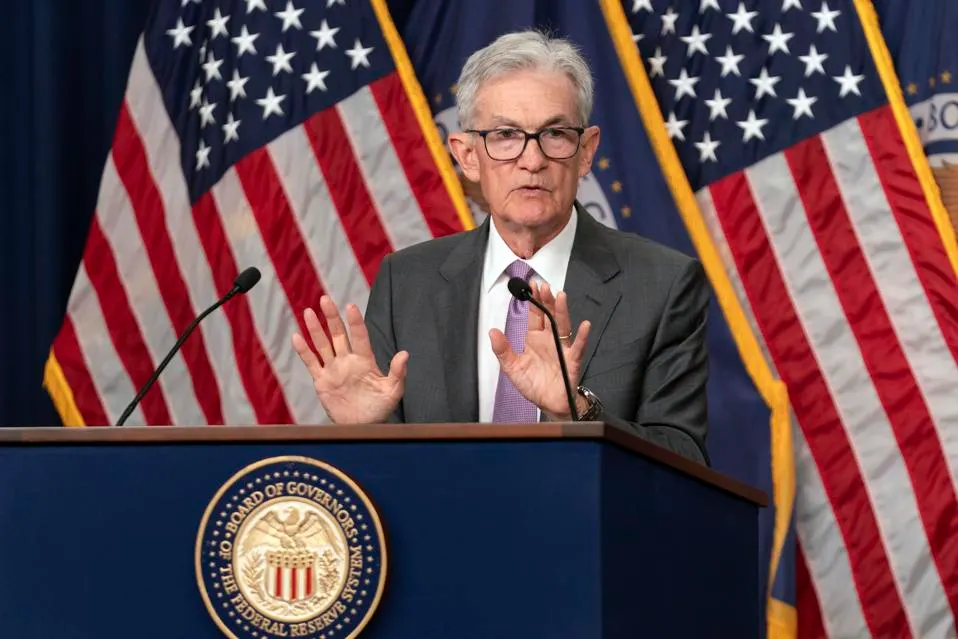
This anticipated rate cut in September would mark the first reduction in the federal funds rate in nearly four years, following a year of maintaining rates at a 23-year high. The Fed reiterated that it would only consider lowering the target range once it has greater confidence that inflation is moving sustainably towards the 2% target. Powell emphasized that while no decisions have been made for future meetings, the central bank is nearing the point where reducing the policy rate might be appropriate if inflation trends align with their expectations.
Federal Reserve Chair Jerome Powell signaled a potential interest rate cut in September if economic conditions align with expectations, as the Fed held rates steady and softened its inflation stance, raising the likelihood of rate reductions amid shifting market concerns.
Mixed Magnificent 7 earnings reports
Microsoft: Microsoft outperformed analyst predictions in its latest quarterly earnings, reporting a 15% year-over-year increase in revenue to $64.7 billion, surpassing the $64.4 billion expected by analysts. Earnings per share (EPS) also exceeded expectations at $2.95. Despite these positive results, the growth of its Azure cloud services fell slightly short of forecasts, rising 29% instead of the anticipated 30-31%. This led to a 7% drop in after-hours trading. CEO Satya Nadella highlighted the company's strong performance and emphasized its commitment to AI innovation. However, questions remain about the long-term revenue impact of AI investments.
Amazon: Amazon reported weaker-than-expected revenue for the second quarter at $147.98 billion, below the $148.56 billion expected. The company also issued a disappointing forecast for the current quarter, with anticipated revenue between $154 billion and $158.5 billion. Despite this, Amazon's EPS of $1.26 beat the expected $1.03. The core retail business continues to face challenges, particularly from competitors like Temu and Shein. Revenue from Amazon Web Services grew to $26.3 billion, slightly above expectations, but advertising revenue fell short at $12.8 billion. CFO Brian Olsavsky noted consumers' preference for cheaper products as a factor in the revenue miss.
Apple: Apple reported fiscal third-quarter earnings that exceeded Wall Street expectations, with revenue rising 5% to $85.78 billion, beating the $84.53 billion estimate. EPS was $1.40, also above the anticipated $1.35. Despite a slight decline in iPhone sales year-over-year, revenue from the iPhone line was strong at $39.30 billion. Other segments like iPad and Services also performed well. However, Apple's revenue in Greater China declined for the fourth consecutive quarter. CEO Tim Cook mentioned the company's increased spending on AI and the upcoming launch of the Apple Intelligence service.
Meta: Meta shares jumped 7% in extended trading after beating Wall Street estimates with $39.07 billion in revenue and $5.16 EPS, exceeding the expected $38.31 billion and $4.73 EPS, respectively. The company forecasted third-quarter revenue between $38.5 billion and $41 billion. Meta reported 22% year-over-year revenue growth, driven by a strong performance in digital advertising. Net income soared 73% to $13.47 billion. Meta's cost-cutting measures, including significant layoffs, helped boost operating income by 58%. CEO Mark Zuckerberg highlighted Meta's advancements in AI and the metaverse, with substantial investments in data center infrastructure and AI technology.
Bank of England cuts rates
The Bank of England has reduced interest rates for the first time in over four years, marking a significant boost to the Labour government’s economic growth agenda. In a closely-contested decision, the Monetary Policy Committee voted five to four to cut the key rate by a quarter of a percentage point to 5 percent. This move follows a period of stable inflation, which returned to the BoE’s 2 percent target in May and remained there in June, despite persistent high services inflation. Announcing the decision, Governor Andrew Bailey emphasized that this cut does not signal a rapid succession of further reductions. "Inflationary pressures have eased enough for us to cut interest rates today," Bailey stated, while cautioning against lowering rates too quickly or by too much to ensure inflation remains under control.
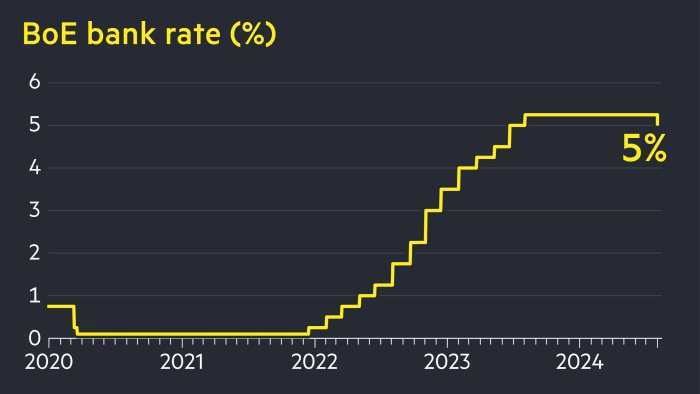
The decision to cut rates, the first since the onset of the COVID-19 pandemic in March 2020, comes after rates had been held steady for nearly a year. The reduction, although anticipated by some economists, had only a 60% probability according to financial markets. Governor Bailey described the decision as an "important moment in time". The rate cut aims to alleviate pressure on household finances, particularly for homeowners with tracker or variable rate mortgages, who will see immediate reductions in monthly payments. However, those on fixed rate mortgages still face higher rates when their deals expire. Bailey stressed the need for careful monitoring to maintain low inflation while cautiously navigating future rate adjustments.
What's Ahead
Central Bank Watch: A light week for central banks, we get the Bank of Japan Monetary Policy Meeting Minutes on Monday and the Reserve Bank of Australia Interest Rate Decision and Monetary Policy Statement on Tuesday.
Macro Data Watch: A quiet week for macroeconomic data, the key macro releases this upcoming week are the global Composite and Service PMI data on Monday.
Date
Major Macro Data
08/05/2024
Global Composite and Service PMI; US ISM Service PMI; BoJ Monetary Policy Meeting Minutes
08/06/2024
EU Retail Sales; RBA Interest Rate Decision and Monetary Policy Statement; German Factory Orders
08/07/2024
Chinese Trade Report, German Industrial Production
08/08/2024
Nothing of note
08/09/2024
Chinese CPI, PPI; German CPI; Canadian Employment Report
.jpg)