
Week commencing August 26th 2024
TradeDay Macro Matters
Macroeconomic / Geopolitical developments
- US and global stocks rally as yields move lower
- Fed Minutes and Powell at Jackson Hole, point to a more dovish Fed
- Payroll revision also sends bond yields lower and stocks higher
- Nvidia earnings and US PCE inflation data in the spotlight into August end
- What's Ahead
US and global stocks rally as yields move lower
Global stock markets rallied as expectations grew for upcoming interest rate cuts from the Federal Reserve and the European Central Bank. In the US, the Dow Jones Industrial Average surged nearly 1.3%, S&P 500 Index rose 1.45% and the Nasdaq added 1.4% from last week. This surge caused the Dow and S&P 500 toward record highs, bolstered by Federal Reserve Chair Jerome Powell's announcement that rate cuts were imminent. The S&P 500, NASDAQ, and Dow gains built on the previous week's gains despite a choppy start. Small-cap stocks, represented by the Russell 2000 Index, outperform large-caps, jumping 3% on the day of Powell's speech due to the anticipated easing of borrowing costs.
In Europe, major stock indexes also saw gains, with the pan-European STOXX Europe 600 Index climbing 1.31%. The German DAX increased by 1.70%, France’s CAC 40 rose by 1.71%, and Italy’s FTSE MIB advanced by 1.83%, reflecting optimism about potential rate cuts. The UK’s FTSE 100 Index also edged higher by 0.20%. Meanwhile, in Asia, Japan's Nikkei 225 and TOPIX indexes posted modest gains of 0.8% and 0.2%, respectively. However, Chinese stocks lagged, with the Shanghai Composite and CSI 300 indexes experiencing declines amid cautious sentiment.
Bond markets reflected the shifting sentiment as well, with US Treasury yields declining sharply. The yield on the 10-year US Treasury fell to 3.76%, near a year-to-date low, in response to revised job growth figures and increasing anticipation of rate cuts.
Fed Minutes and Powell at Jackson Hole, point to a more dovish Fed
Federal Reserve Chair Jerome Powell’s speech at the Jackson Hole Symposium on Friday indicated a more dovish stance from the central bank, suggesting that the “time has come” for interest rate cuts. Powell’s comments highlighted that while inflation is nearing the Fed's 2% target, the labor market shows signs of cooling, which could warrant policy easing. He emphasized that the direction toward rate cuts is clear, but the timing and pace will depend on incoming data and the evolving economic outlook. This acknowledgment of recent progress on inflation and economic stability reassured markets, which have been eagerly anticipating a shift in monetary policy.

The dovish tone of Powell’s remarks reinforced the FOMC meeting minutes from Wednesday, which revealed that a majority of officials are inclined toward rate cuts if economic data aligns with expectations. The minutes showed that while the committee voted to hold rates steady at the July meeting, there was growing consensus for a rate cut in September, particularly if signs of economic slowdown persist. With Powell’s confirmation that easing is on the table, market expectations are solidifying around a September cut, which would mark the first reduction since the emergency measures taken during the early days of the COVID-19 pandemic.
Markets responded positively to Powell's dovish shift, with stocks rallying and bond yields falling as investors priced in the likelihood of imminent rate cuts. Powell's clear indication that the Fed is prepared to adjust policy to prevent further economic slowdown has boosted confidence that a "soft landing" is achievable, balancing growth and inflation. This shift in Fed policy marks a critical moment for financial markets, signaling a transition from a period of high-interest rates aimed at curbing inflation to one that focuses on sustaining economic growth without triggering a recession.
Payroll revision also sends bond yields lower and stocks higher
The recent revision to the U.S. payroll data by the Bureau of Labor Statistics (BLS) sent shockwaves through financial markets, causing bond yields to drop and stocks to rise. Released after a delay that caused confusion among economists, the data showed that payrolls were likely overstated by 818,000 jobs for the 12 months ending in March 2024. This revision, the largest downward adjustment since 2009, suggests that the average monthly job growth was around 174,000, significantly lower than the previously estimated 240,000. Investors quickly interpreted this weaker job market data as a sign that the Federal Reserve might move more aggressively towards cutting interest rates to support the economy. As a result, the benchmark S&P 500 index rose by about 0.4% on the day, while the yield on the 10-year U.S. Treasury bond fell to as low as 3.6% before settling around 3.8%.
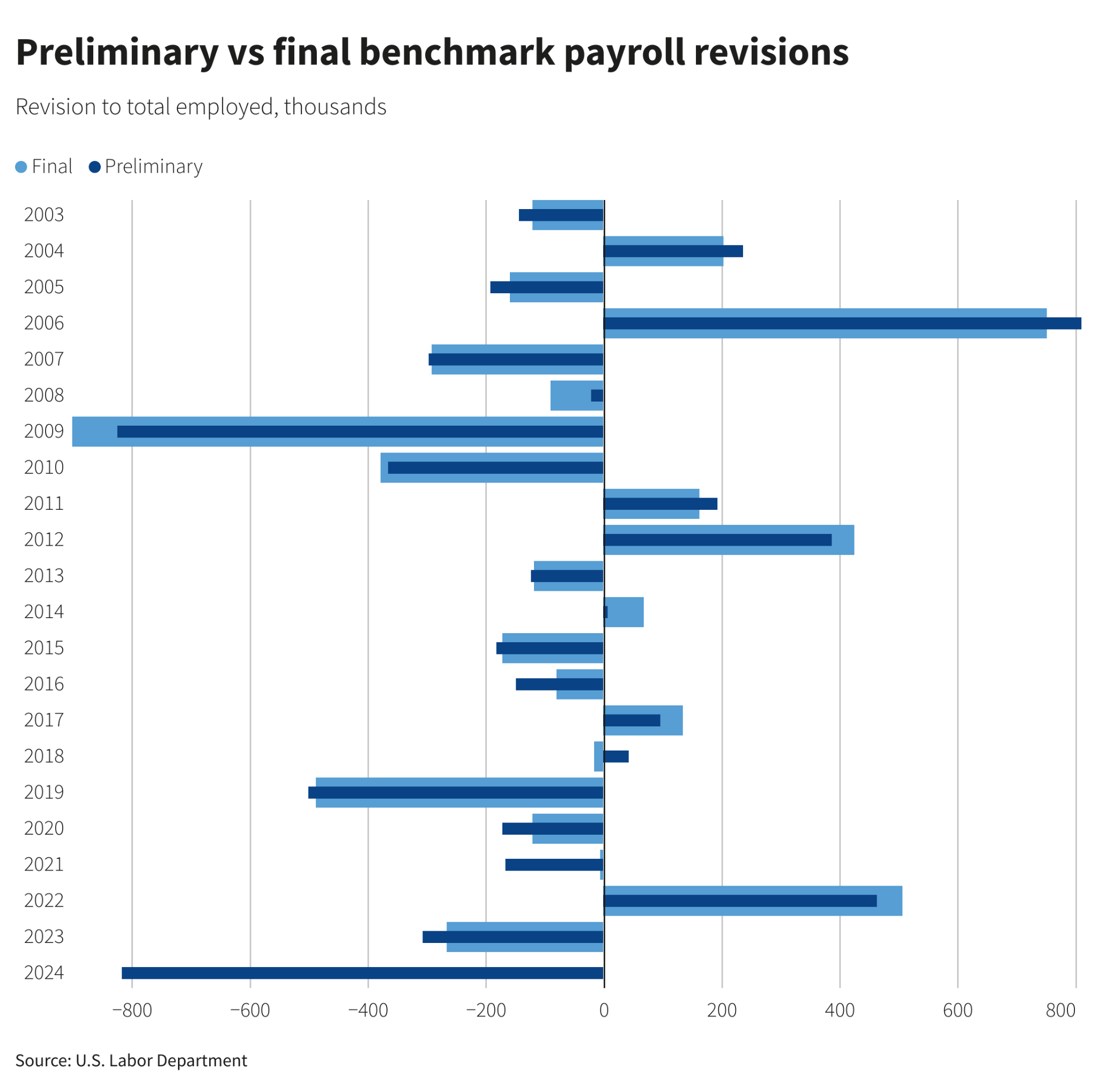
While the revision indicates a notable slowdown in job growth, analysts emphasized that the U.S. economy is not "falling off a cliff." Despite the downward adjustment, the labor market's growth rate remains "pretty healthy," with the revised figures still reflecting an economy that is expanding, albeit at a cooler pace than initially thought. The revised data also highlights that the Federal Reserve may have been slower to recognize the labor market's cooling, which could prompt a more accommodative stance in upcoming policy meetings. This potential shift in Fed policy was welcomed by both equity and bond markets, which saw a rally on expectations of lower interest rates moving forward.
Nvidia earnings and US PCE inflation data in the spotlight into August end
As August draws to a close, all eyes are on two key events that could shape market sentiment: Nvidia’s earnings report and the US Personal Consumption Expenditures (PCE) inflation data. Nvidia is set to release its fiscal second-quarter earnings on Wednesday, with analysts expecting a significant increase in both earnings and revenue, projected at $0.64 per share and $28.7 billion, respectively. Additionally, Nvidia's guidance for the third quarter will be closely watched, with revenue expected to reach $31.7 billion and earnings per share to rise to $0.71. With implied volatility levels high and call demand outweighing put demand, investors are anticipating a substantial post-earnings move in Nvidia's share price. However, due to the high expectations set by previous performance, anything less than stellar results could lead to a sharp decline in the stock price, especially given the stock's recent struggle to break through resistance levels.

Meanwhile, the upcoming release of the July Personal Consumption Expenditures (PCE) data on Friday is poised to be another major market mover. The Fed's decision-making remains data-dependent, and the PCE figures will provide crucial insight into inflation trends, which are central to the Federal Reserve's policy outlook. Market forecasts suggest that both the headline and core PCE price indices may show modest increases, while personal consumption is expected to grow by 0.5% month-on-month. With the Fed's September meeting on the horizon and the possibility of rate cuts in focus, any deviation from these expectations could significantly influence the rate path going forward. A higher-than-expected PCE reading could dampen hopes for aggressive rate cuts, while weaker data could bolster the case for easing monetary policy.
What's Ahead
Central Bank Watch: No significant central bank activity this week, but Fed speakers will be key as always.
Macro Data Watch: The main macro data release this week is the US PCE data on Thursday and Friday, with Friday’s data key. Some other releases of note are the US Consumer Confidence Tuesday, GDP on Thursday, Japanese, German and EU Unemployment Reports on Friday and EU CPI on Friday.
Earnings Watch: Nvidia is set to release its fiscal second-quarter earnings on Wednesday.
Date
Major Macro Data
08/26/2024
UK Bank Holiday; German IFO; US Durable Goods Orders
08/27/2024
German GfK Consumer Confidence and GDP; US Consumer Confidence
08/28/2024
Nothing of note
08/29/2024
EU Consumer Confidence; German CPI; US GDP, PCE (QoQ)
08/30/2024
Japanese CPI, Unemployment Report; German Retail Sales, Unemployment Report; EU CPI, Unemployment Report; Canadian GDP; US PCE (YoY, MoM); Michigan Consumer Sentiment Index; Chicago Purchasing Managers' Index
.jpg)