
Week commencing August 19th 2024
TradeDay Macro Matters
Macroeconomic / Geopolitical developments
- US and global stock market rebound continues
- Cooling CPI adds to positive sentiment
- US hard landing fears abate with solid US Retail Sales
- Fed Minutes in focus this week with rate cuts expected
- What's Ahead
US and global stock market rebound continues
The US stock market experienced its best week of 2024, with major indices posting impressive gains as fresh economic data helped to alleviate fears of a potential recession. The S&P 500 surged nearly 4%, while the Nasdaq Composite climbed over 5.2%, and the Dow Jones Industrial Average rose almost 3%. This robust recovery was driven by easing inflation and stronger-than-expected economic reports, which have bolstered investor confidence. The rally was further supported by a rebound in the technology and growth sectors, which had been hit hardest during the recent market downturn.
Globally, stock markets followed the US lead, with European and Asian markets also posting significant gains. European stocks closed the week higher, with the Stoxx 50 and the pan-European Stoxx 600 both showing strong performances as fears of a US recession receded. Positive US economic data, including lower inflation, strong retail sales, and stable consumer sentiment, reassured investors that the economy remains on a stable growth trajectory. In Asia, major indices such as Japan's Nikkei, Hong Kong's Hang Seng, and India's S&P BSE Sensex all posted solid gains, reflecting the global optimism surrounding economic conditions and market stability.
As the markets head into the coming weeks, the focus will likely shift towards the potential for further gains, especially as the Federal Reserve appears poised to begin cutting interest rates. The continued moderation in inflation and broadening of earnings growth beyond just technology and growth sectors suggest that the market's upward momentum could persist, even as seasonal volatility approaches. Investors are optimistic that a "soft landing" for the economy is achievable, with a balanced mix of growth and value sectors potentially leading the way in the next phase of the market cycle.
Cooling CPI adds to positive sentiment
The July Consumer Price Index (CPI) report revealed a lower-than-expected rise in inflation, with headline annual inflation increasing by 2.9%, the lowest rate since March 2021. This marks a significant milestone as inflation dips below 3% for the first time in over three years, signaling that the Federal Reserve's efforts to curb inflation are proving effective.
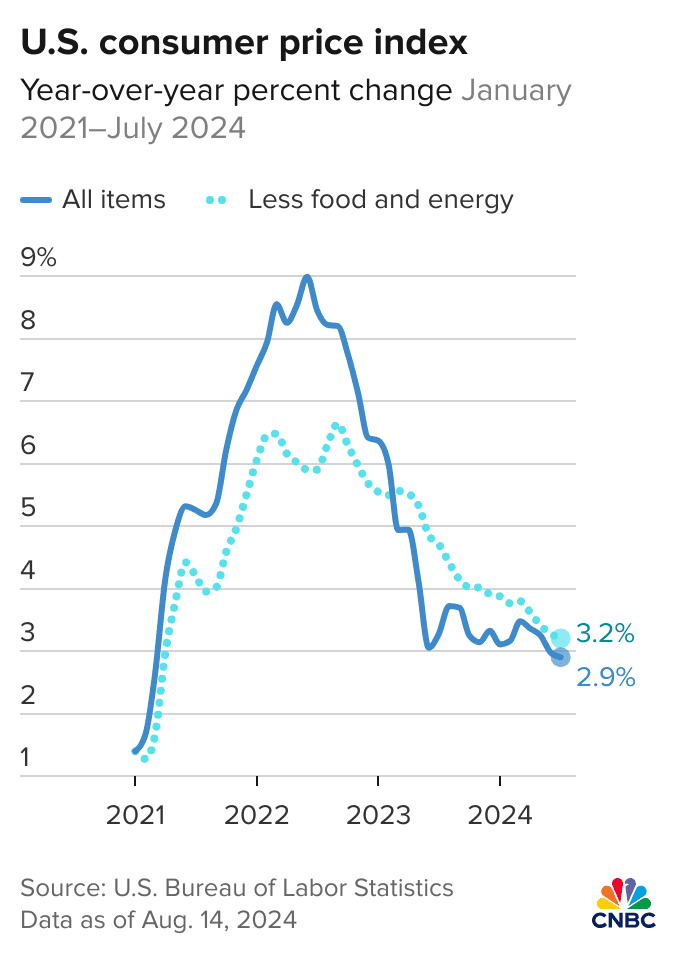
Month-on-month, prices rose by 0.2%, slightly below expectations, reinforcing the belief that inflation is gradually coming under control. This cooling of price pressures strengthens the case for a potential rate cut by the Fed in September, as the central bank appears increasingly confident that it is on track to achieve its 2% inflation target.
With inflation moderating, the Fed may shift its focus toward maximizing employment, potentially reducing borrowing costs to stimulate job growth. The easing inflationary trend has injected positive sentiment into the market, as investors anticipate a more accommodative monetary policy ahead.
US hard landing fears abate with solid US Retail Sales
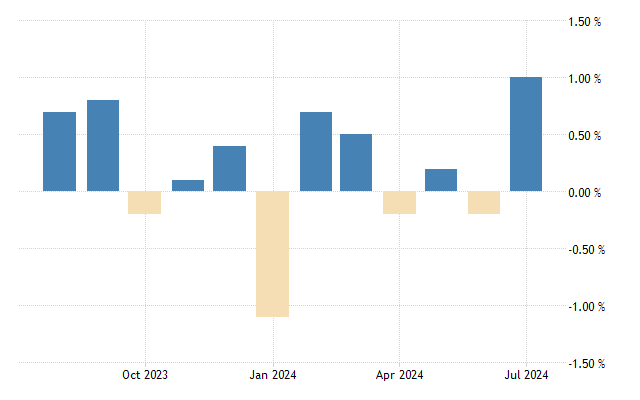
Fears of a hard landing in the US economy were significantly eased following stronger-than-expected retail sales data for July, which highlighted the resilience of consumer spending. The Commerce Department reported a 1.0% increase in retail sales, surpassing analyst expectations and signaling that the world's largest economy is holding up well despite the Federal Reserve's high interest rates. This robust performance helped stocks climb, with the S&P 500 rising by about 1.5%, while Treasury yields surged, particularly in shorter maturities, as investors recalibrated their expectations for future Fed actions.
The positive retail sales figures, coupled with a decline in jobless claims to their lowest level since early July, further diminished fears of an imminent recession. This has led to a shift in market sentiment, where good economic news is once again being seen as favorable for markets, rather than as a precursor to aggressive rate cuts by the Fed. Swap traders have notably reduced bets on large-scale Fed easing, as the stronger retail data provides the central bank with some breathing room ahead of its September meeting.
Economists, including Aditya Bhave from Bank of America, interpreted the July retail sales as consistent with a "soft landing" scenario, where the Fed can achieve its inflation targets without triggering a significant economic contraction. While speculation of a 50-basis-point rate cut in September has diminished, the current outlook favors a more measured quarter-point reduction, with another possible cut in December.
Fed Minutes and Jackson Hole in focus this week
This week, market attention will be squarely on the Federal Reserve, particularly the release of the FOMC Meeting Minutes on Wednesday, August 21. Investors will scrutinize these minutes for insights into the Fed's assessment of the US economy, labor market, and future rate path. While the minutes are significant, the broader focus will be on the upcoming Jackson Hole Economic Symposium, where Fed Chair Jerome Powell is set to deliver a highly anticipated speech. His comments are expected to provide crucial hints on the timing and magnitude of potential interest rate cuts, especially as markets anticipate a rate reduction in September.

As the Jackson Hole Symposium unfolds from August 22 to 24, with key global central bank officials and economists in attendance, Powell’s keynote speech on Friday is expected to be the highlight. Investors will be looking for any signals indicating the Fed's readiness to ease monetary policy, with particular interest in Powell's stance on the labor market and its influence on future rate decisions. The possibility of further rate cuts in November and December is also on the radar.
What's Ahead
Central Bank Watch: The main focus will be on FOMC Minutes on Wednesday and Jackson Hole Symposium from Thursday. Other central bank activities this week are the People’s Bank of China Interest Rate decision on Tuesday and the Reserve Bank of Australia Meeting Minutes also on Tuesday.
Macro Data Watch: The key macro data releases this week are the global Flash PMI data on Thursday and the EU, Canadian and Japanese CPI data throughout the week.
Date
Major Macro Data
08/19/2024
Nothing of note
08/20/2024
PBoC Interest Rate decision; RBA Meeting Minutes; German PPI; EU CPI; Canadian CPI
08/21/2024
FOMC Minutes
08/22/2024
Global Manufacturing, Composite and Service Flash PMI; Jackson Hole Symposium
08/23/2024
UK Consumer Confidence; Japanese CPI; Canadian Retail Sales; Jackson Hole Symposium
.jpg)