
Week commencing June 3rd 2024
TradeDay Macro Matters
Macroeconomic / Geopolitical developments
- Global stocks lower as yields spike towards 2024 peaks
- Higher yields pressures from “higher for longer” fears
- US PCE data inline, stocks rebound
- Fed enters blackout period with eyes on global PMI and US Employment data
- What's Ahead
Global stocks lower as yields spike towards 2024 peaks
Global stock markets experienced sharp declines as US Treasury yields spiked to four-week highs, with the benchmark US 10-year yield climbing to 4.62%, up from 4.47% at the end of last week. The two-year to 30-year yields also reached their highest levels since early May, reflecting heightened concerns about inflation and economic growth. The narrowing of the 2-year/10-year yield curve to its smallest gap in two weeks, highlighted investor worries about the prolonged period of high interest rates.
The surge in US Treasury yields, driven by upbeat economic data and a disappointing government debt auction, has pressured risky assets worldwide. US equities fell significantly, with the trend extending to Asian and European markets
The rising yields and subsequent sell-off in equities were further fueled by an unexpected improvement in US Consumer Confidence for May, which contrasted with predictions of a fourth straight month of weaker confidence. This has led to increased uncertainty about the Federal Reserve's interest rate policy, with investors now doubting the likelihood of near-term rate cuts. Additionally, European bond yields rose following disappointing German inflation data, with German, French 10-year yields jumping, and UK 10-year gilt yields climbing too. As a result, investor risk sentiment deteriorated, impacting global stock markets and driving a steepening of the yield curve.
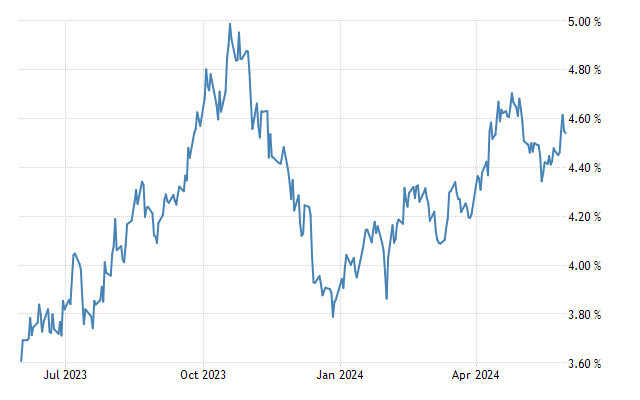
US 10yr yield chart
Higher yields pressures from “higher for longer” fears
In the US, the strength of the economy has led traders to reduce their expectations for Federal Reserve rate cuts, maintaining higher yields even as they have risen again in recent weeks. As highlighted above, the recent rise in US Treasury yields, driven by strong economic data and a disappointing government debt auction, has pressured risky assets globally, with significant declines in US, Asian, and European stock markets.
The "higher-for-longer" interest rate strategy is likely to be the main approach for central banks throughout 2024, driven by the need to control stubborn inflation. This stance has been reinforced by hawkish comments from Federal Reserve officials, which have dampened market sentiment and signaled that rate cuts are increasingly unlikely this year. Minneapolis Fed President Neel Kashkari highlighted the possibility of further rate increases, reinforcing the Fed’s cautious approach aimed at ensuring inflationary pressures are firmly managed before considering rate reductions. Similarly, the Bank of England (BoE) is expected to maintain higher rates, influenced by upcoming general elections, while the European Central Bank (ECB) may cut rates gradually in response to slowing inflation, with a potential rate cut anticipated for June 6 and possibly one more later in the year.

US PCE data inline, stocks rebound
US Treasuries moved higher on Friday following the release of closely watched inflation data, continuing their rebound from the previous session. The benchmark ten-year note's yield fell 4.0 basis points to 4.51%, adding to the 7.0 basis point drop seen on Thursday, further pulling back from its highest levels in almost a month. This strength came after the Commerce Department reported that consumer prices in April increased in line with economist estimates, while core consumer prices rose slightly less than expected.
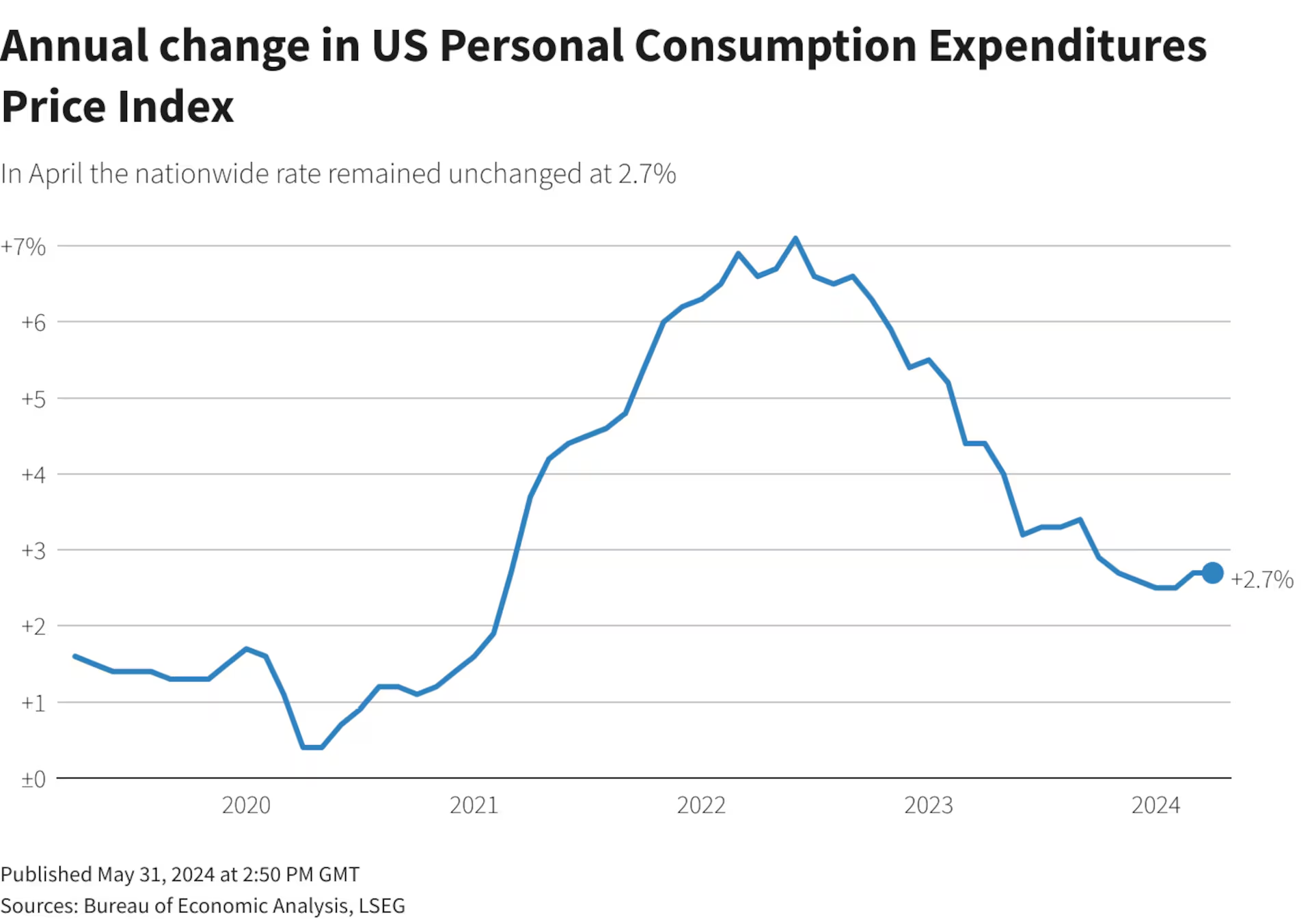
The Commerce Department's report showed the personal consumption expenditures (PCE) price index rose by 0.3% for the third consecutive month in April, meeting expectations. The core PCE price index, which excludes food and energy prices, increased by 0.2%, slightly below the 0.3% forecast. On an annual basis, the PCE and core PCE price indexes remained steady at 2.7% and 2.8%, respectively, matching expectations.
US equities rebounded mildly on Friday, reversing the week's losses after the inflation data matched expectations and showed signs of cooling. This lack of surprises in the PCE index was welcomed by investors, reinforcing the likelihood of an interest rate cut later this year.
Fed enters blackout period with eyes on global PMI and US Employment data
As the Federal Reserve transitions into its blackout period from June 1, investors are closely monitoring a barrage of economic data both domestically and globally, with a keen focus on how these indicators might influence future monetary policy decisions.
In the United States, attention is directed towards pivotal events such as the ISM Manufacturing PMI on Monday, which could elicit concerns of a potential hard landing if there's a significant contraction in the manufacturing sector. Market moves could also be shaped more by JOLTs Job Openings on Tuesday and the ADP nonfarm employment and ISM Services PMI figures on Wednesday, as they provide crucial insights into the labor market's health. Weaker labor market conditions coupled with pronounced contractions in the services sector could amplify speculation around a potential rate cut by the Fed in September, heightening market volatility.
However, all eyes will be on Friday's US Jobs Report, where indicators such as wage growth and nonfarm payrolls will be scrutinized for clues about the Fed's future policy stance. This heightened attention on economic data is compounded by the absence of any Fed speeches during the blackout period, leaving investors to rely solely on incoming data for insights into the central bank's outlook.
While the US economic calendar dominates market attention, global PMI data is also poised to play a significant role in shaping market movements and broader economic sentiment. In the Eurozone, Monday's Manufacturing PMIs and Wednesday's Services PMIs, alongside the ECB's Interest Rate Decision, Policy Statement and Press Conference on Thursday are all key.
What's Ahead
Central Bank Watch: The main central bank activities this week are the Bank of Canada Interest Rate Decision and Policy Statement on Wednesday and the EU Monetary Policy Statement on Thursday.
Macro Data Watch: The main macro data released this upcoming week are the global PMI data throughout the week and the US Employment data on Friday.
Date
Major Macro Data
06/03/2024
Global Manufacturing PMI; US ISM Manufacturing PMI
06/04/2024
German Unemployment Change, Rate; US Factory Orders and JOLTS Job Openings
06/05/2024
Global Service PMI; US ISM Service PMI; Bank of Canada Interest Rate Decision and Policy Statement
06/06/2024
German Factory Orders; EU Retail Sales, ECB Interest Rate Decision, Policy Statement and Press Conference
06/07/2024
Chinese Trade data; EU Employment change and GDP; US and Canadian Employment reports
.jpg)