
Week commencing July 29th 2024
TradeDay Macro Matters
Macroeconomic / Geopolitical developments
- Stock rotation continues
- Google and Tesla weigh on big tech/ growth stocks
- PCE data slightly warmer than expected
- A super busy week in focus: Fed, BoE, 4x Magnificent Seven earnings, PMI plus US Jobs!
- What's Ahead
Stock rotation continues
The ongoing stock rotation has been marked by a notable shift away from mega-cap technology stocks, despite a strong earnings season where 78% of the 136 S&P 500 companies that reported last week exceeded earnings expectations. The S&P 500 fell by 0.8% for the week, with the Magnificent 7 - comprising Microsoft, Meta Platforms, Amazon, Apple, NVIDIA, Alphabet, and Tesla - leading the decline with a collective loss of 3.9%. This trend was largely driven by Tesla's disappointing earnings and Alphabet's earnings surpassing expectations, yet still resulting in a price loss. Since July 9, Tesla has been the worst performer among the Magnificent 7, followed closely by Meta and NVIDIA, despite their higher than expected year-over-year earnings growth rates.
As mega-cap technology stocks faltered, smaller companies outperformed, reflecting a market rotation that began on July 9. Small-cap stocks surged by 11.4%. Midcap stocks also joined this upward trend with a 4.5% gain. This shift has significantly improved the market’s breadth, with the average S&P 500 stock rising by 2.2% since July 9, after a period of decline in the second quarter. Notably, the less economically sensitive defensive stocks slightly outperformed the more exposed cyclical stocks, suggesting a reversal of cyclical outperformance rather than a signal of economic troubles. The outperformance of banks and small-cap stocks further supports the notion that there is no imminent recession risk.
This change in the stock market's dynamics indicates a possible waning of the dominance of mega-cap tech companies like Nvidia and Microsoft, which had propelled major indexes higher in the first half of the year. As investor confidence grows in anticipation of the Federal Reserve potentially lowering interest rates soon, there is a renewed focus on shares of businesses that could benefit from economic growth, including smaller companies, banks, and real estate businesses. This transition, while still in its early stages, suggests broader market leadership and a shift away from the previous tech-driven rally, as evidenced by the market's worst day since late 2022 on Wednesday. However, the impact of this shift remains uncertain, as replacing tech stocks with smaller companies might not replicate the same rapid gains seen earlier in the year.
Google and Tesla weigh on big tech/ growth stocks
The S&P 500 and Nasdaq closed at multi-week lows on Wednesday, as disappointing earnings from Alphabet and Tesla shook investor confidence in major tech stocks. This led the S&P 500 to snap its longest streak without a daily decline of more than 2%, posting its worst one-day performance since December 2022 with a 2.3% drop. The Nasdaq Composite also experienced significant losses, marking its largest single-day percentage decline since October 2022, driven by underwhelming quarterly results from some of the market’s most influential companies.

Tesla's shares plummeted by 12.3%, their worst single-day drop since September 2020, after the company reported its lowest profit margin in over five years and missed second-quarter earnings estimates. Alphabet, the parent company of Google, saw its shares fall by 5%, despite beating second-quarter earnings expectations, as concerns over an advertising slowdown and high capital expenses overshadowed the results. This decline contributed to a broader sell-off in the so-called "Magnificent Seven" tech stocks, which include Microsoft, Amazon, Alphabet, Tesla, Meta (Facebook), Nvidia, and Apple. The collective drop in these tech giants underscored the market's vulnerability to their performance, signaling wider apprehensions about the sustainability of their high valuations.

PCE data slightly warmer than expected
A crucial piece of U.S. inflation data came in slightly hotter than anticipated last month, adding complexity to the Federal Reserve's deliberations on when to start cutting interest rates. The core personal consumption expenditures (PCE) price index, the Fed’s preferred inflation gauge, remained unchanged at 2.6% in June, slightly above the 2.5% forecasted by economists. This minor yet significant deviation has raised concerns among investors hoping for a more imminent rate cut.
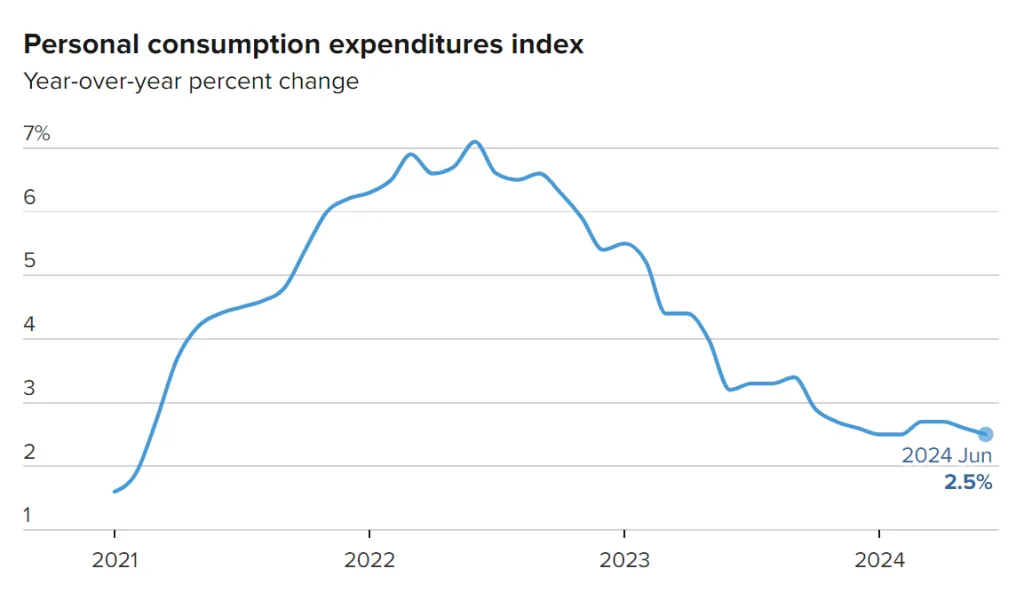
The data revealed that services inflation stayed persistently high, rising 3.9% over the year to June, while goods prices decreased and food inflation moderated. Additionally, consumer spending saw a modest increase of 0.2% in June. Following a surprisingly robust GDP release, these figures suggest that the U.S. economy is still resilient despite the Fed’s aggressive rate hikes. As the Federal Reserve meets next week to discuss interest rates, markets are almost certain that rates will remain on hold, though there is growing confidence that a rate cut could occur in September. Market pricing currently shows a 5% probability of a rate cut at this week's meeting, but nearly 100% certainty of a quarter-point cut by the September 18 meeting, reflecting heightened anticipation for easing monetary policy amid persistent inflation concerns.
A super busy week in focus: Fed, BoE, 4x Magnificent Seven earnings, PMI plus US Jobs!
Earnings: The week beginning Monday, July 29, will be the busiest of the third quarter, with traders closely monitoring a plethora of company earnings announcements and macroeconomic data releases. Notably, four of the Magnificent Seven companies—Microsoft, Apple, Meta Platforms, and Amazon—are set to report their quarterly earnings. Microsoft is scheduled for Tuesday, with expectations of a rise in fourth-quarter revenue driven by strong demand for its AI-powered cloud and business software offerings. Meta Platforms will follow on Wednesday, with projections of increased second-quarter revenue due to heightened ad spending. On Thursday, Amazon is expected to report a jump in second-quarter revenue, thanks to robust cloud-computing demand, while Apple is anticipated to announce a rise in third-quarter revenue, bolstered by new iPad launches and its services business.
Central Banks: In addition to corporate earnings, it's a critical week for monetary policy decisions. The US Federal Reserve and the Bank of England are both set to make their latest interest rate decisions, with most economists predicting no change in their benchmark rates. However, the Fed's meeting on Wednesday is particularly significant as it may signal a potential rate cut in September, recognizing that inflation has edged closer to the central bank's 2% target. Similarly, the Bank of England's decision, due on Thursday, is expected to maintain the current interest rate, despite market speculation. The Bank of Japan, also meeting on Wednesday, is anticipated to discuss a possible rate hike and plans to moderate its bond purchase program.
Macro data: The economic calendar for the week is equally packed, with the US Labor Department's employment report and manufacturing data taking center stage. The employment report, due Friday, is forecasted to show a rise in nonfarm payrolls by 175,000 jobs in July, down from 206,000 in June, with the unemployment rate holding steady at 4.1%. Additionally, the Institute for Supply Management's manufacturing PMI and the S&P Global manufacturing PMI will be released on Thursday, providing further insights into the sector's performance. Other key data include the Job Openings and Labor Turnover Survey (JOLTS) report on Tuesday, expected to show 8 million job openings in June, and the ADP Employment report on Wednesday, forecasting a 149,000 increase in private payrolls for July.
What's Ahead
Central Bank Watch: The main central bank activities this week are the Bank of Japan Interest Rate Decision and Monetary Policy Statement on Tuesday, Federal Reserve Interest Rate Decision and Monetary Policy Statement on Wednesday and the Bank of England Interest Rate Decision, Monetary Policy Statement and Minutes on Thursday.
Macro Data Watch: The main macro data release this week is the Global Manufacturing PMI and US ISM Manufacturing PMI on Thursday and the US Job Report on Friday . Some other releases of note are the EU GDP on Tuesday, EU CPI on Wednesday and US Factory Orders on Friday.
Earnings Watch: Key focus will be on four of the Magnificent Seven earnings next week; with Microsoft on Tuesday, Meta on Wednesday, then Apple and Amazon on Thursday.
Date
Major Macro Data
07/29/2024
Nothing of note
07/30/2024
EU GDP; Japanese Employment Report; German CPI and GDP
07/31/2024
BoJ Interest Rate Decision, Monetary Policy Statement; German Retail Sales, Employment Report; EU CPI; Fed Interest Rate Decision, Monetary Policy Statement
08/01/2024
Global Manufacturing PMI;US ISM Manufacturing PMI; BoE Interest Rate Decision, Monetary Policy Statement, Minutes
08/02/2024
US Employment Report, Factory Orders
Date
Major Earnings Data
07/29/2024
McDonald’s
07/30/2024
Microsoft; P&G; Merck&Co; AMD; Pfizer; S&P Global; Stryker; Starbucks; PayPal
07/31/2024
Meta Platforms; Mastercard; T-Mobile US; Qualcomm; Arm
08/01/2024
Apple; Amazon; Intel
08/02/2024
Exxon Mobil; Chevron; Linde Plc
.jpg)