
Week commencing July 22nd 2024
TradeDay Macro Matters
Macroeconomic / Geopolitical developments
- Sector rotation continues as tech and growth stocks decline, small cap and value stocks benefits
- US Retail Sales solid
- Fed rate cuts expected from September
- ECB leaves rates unchanged
- Pressure grows on Biden to step aside
- What's Ahead
Sector rotation continues as tech and growth stocks decline, small cap and value stocks benefits
The U.S. stock market is witnessing a notable sector rotation, with small-cap and value stocks gaining momentum as tech and growth stocks falter. This shift is driven by expectations of interest rate cuts and improving prospects for Republican presidential candidate Donald Trump, whose policies are seen as favorable to smaller domestic companies. The Russell 2000, the index focusing on small-cap stocks, surged over 11.5% in five days, marking its biggest gain in such a stretch since April 2020.
In contrast, tech and growth stocks have stumbled, reinforcing the trend of investors moving out of the year’s biggest winners into less favored areas of the market. The tech-heavy Nasdaq 100 has dropped 3% since last week, including its largest one-day decline of the year. While the S&P 500, the benchmark for large-cap U.S. stocks, showed a modest gain of 0.2%, small-cap stocks have started to recover after months of lagging behind. Despite the recent surge, the Russell 2000 is up only 10.5% for the year, compared to the S&P 500's 17% gain and the Nasdaq 100's nearly 18% rise.
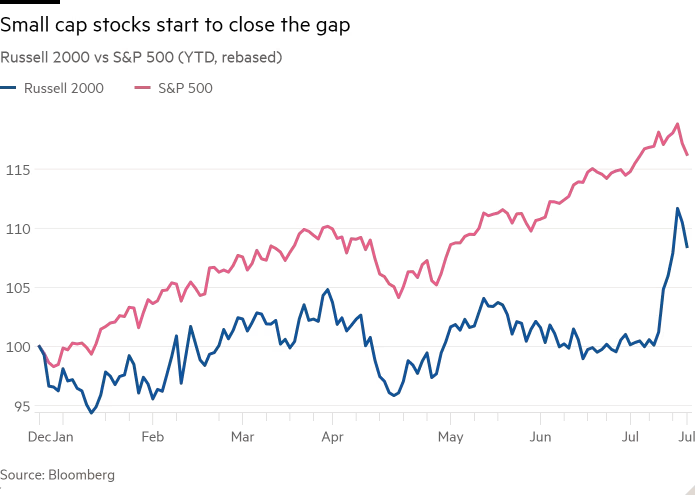
The rotation was catalyzed by a softer-than-expected inflation reading, which boosted expectations of Federal Reserve rate cuts, potentially easing the borrowing costs that have been a headwind for smaller companies. Additionally, a failed assassination attempt last weekend has increased expectations of a Trump victory, which could further benefit smaller firms through proposals to raise tariffs and lower taxes. This sector rotation suggests that big tech stocks are "no longer the only game in town," as investors diversify into smaller companies and previously overlooked sectors.
US Retail Sales solid
U.S. Retail Sales remained unchanged in June, as a drop in receipts at auto dealerships was offset by broad strength in other areas, demonstrating consumer resilience that bolstered economic growth prospects for the second quarter. The Commerce Department's report showed an upward revision of May's sales to a 0.3% increase, reinforcing confidence in the economy despite cooling inflation. This solid performance did not alter expectations for potential Federal Reserve interest rate cuts in September, as fears of a sharp economic slowdown were alleviated.
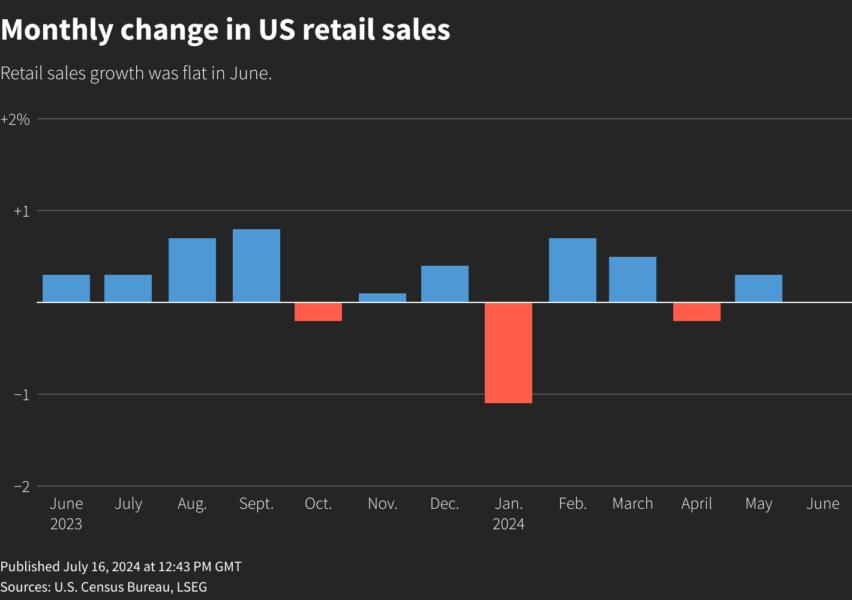
Retail sales in June totaled $704.3 billion, unchanged from May, following the revised 0.3% gain from April to May. Year-over-year, sales increased by 2.3%, though this marks a slowdown from the 7.7% gain recorded in January 2023, reflecting a shift in consumer behavior towards cheaper alternatives after a period of high inflation. Excluding gas prices and auto sales, retail sales rose 0.8%, indicating underlying strength in consumer spending. Sales at gas stations decreased by 0.3%, and auto dealership sales fell by 0.2%, partly due to disruptions from a cyberattack on a software supplier. Despite these sector-specific declines, the overall stability in retail sales underscores the resilience of U.S. consumers amid economic uncertainties.
Fed rate cuts expected from September
Investors are keenly anticipating the Federal Reserve's Sept. 17-18 meeting, as Fed Chair Jerome Powell has indicated that it could mark the beginning of a significant policy shift from fighting pandemic-era inflation to easing monetary policy. The transition is expected to start with an interest rate cut, contingent on favorable economic data, including continued progress toward the Fed's 2% inflation target and a balanced labor market with modest wage and job gains. Although the Fed is likely to maintain its benchmark interest rate at 5.25%-5.50% during the July 30-31 meeting, the policy statement might hint at the groundwork for a potential rate cut in September.
The period between the July and September meetings is particularly critical, providing an extended seven-week interval for data accumulation, including inputs from the Kansas City Fed's annual research conference in Jackson Hole, Wyoming. This interval is seen as an opportunity for Fed officials to solidify their views based on new economic insights. New York Fed President John Williams has emphasized the importance of this period, noting that "we're actually going to learn a lot between July and September." For more than two years, the Fed's focus on combating inflation has overshadowed other concerns, but a shift toward easing rates is now eagerly awaited by global markets, buoyed by growing confidence in achieving price stability.
Top Fed officials, including Governor Christopher Waller and President John Williams, have recently underscored the proximity of an interest rate cut, setting the stage for a potential reduction in borrowing costs as early as September. While they have ruled out a rate cut at the July meeting, their remarks suggest that conditions for a cut could align between September and December. This cautious approach is intended to ensure that the Fed does not miss the chance to achieve a soft landing for the US economy, which is beginning to show signs of slowing. The markets have already started pricing in these expectations, with the probability of a rate cut in September gaining traction among investors.
ECB leaves rates unchanged
The European Central Bank (ECB) decided to keep its key deposit rate unchanged at 3.75 percent, as anticipated, while signaling the possibility of a second interest rate cut at its upcoming meeting in September. ECB President Christine Lagarde, who has been optimistic about an economic recovery driven by domestic demand, cautioned that the risks to growth are skewed to the downside. She indicated that 2024 would likely see "muted growth, accompanied by heightened uncertainty," and downplayed recent persistent inflation, attributing it to one-off factors.
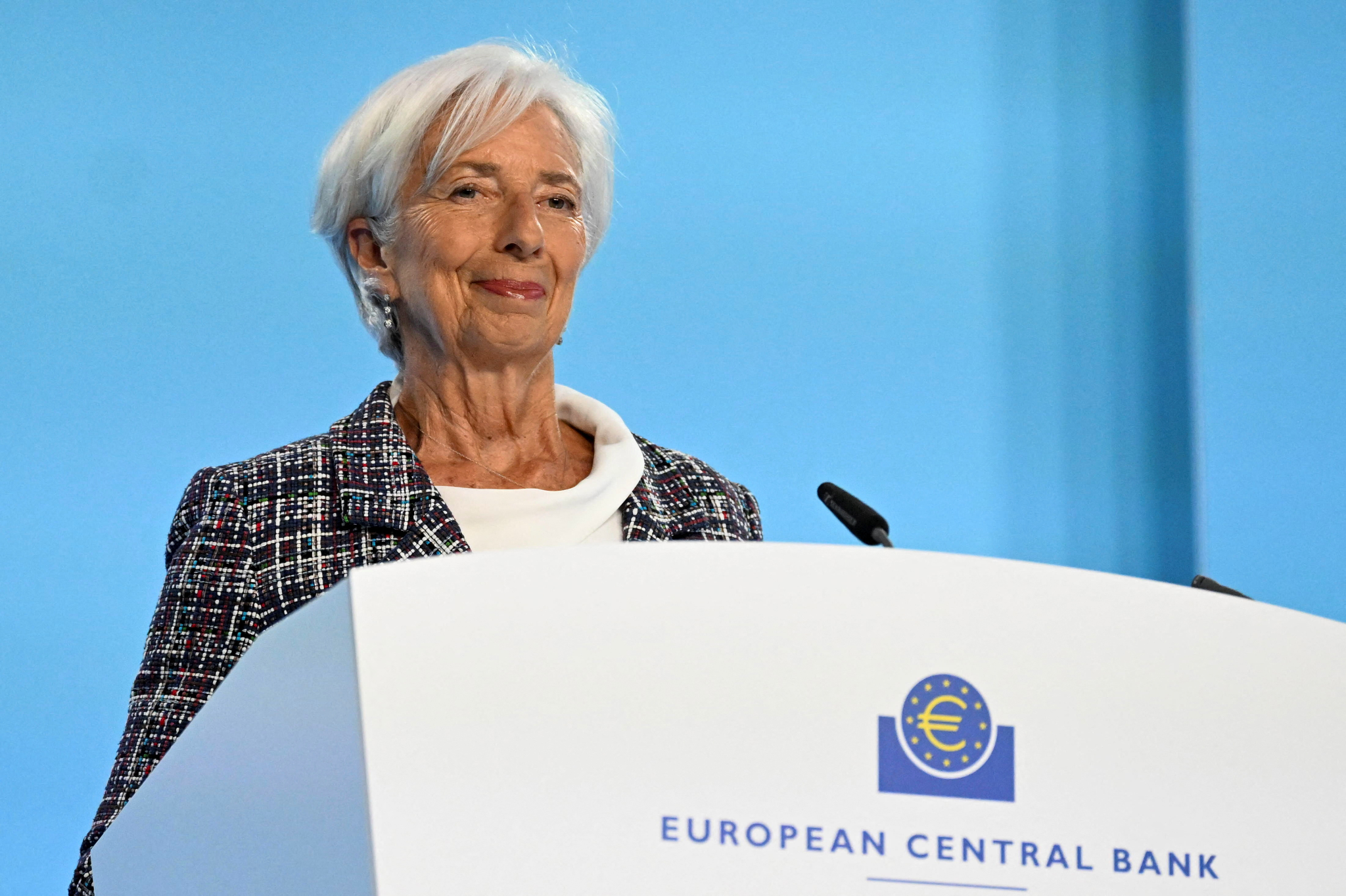
Following the announcement, the euro initially remained stable but eventually slipped a quarter of a cent against the dollar, reflecting expectations of further rate cuts. Eurozone government bond yields, particularly shorter-dated ones sensitive to ECB rate outlooks, also fell, with Italy’s benchmark two-year note yield hitting a six-month low of 3.09 percent. While the ECB had cut rates from record highs last month, it is now adopting a more cautious approach regarding subsequent steps. Investors are increasingly betting on another reduction in September, bolstered by Lagarde's comment that growth risks are "tilted to the downside." Markets are also pricing in nearly two rate cuts for the remainder of the year and more than five by the end of 2025, a perspective unchallenged by policymakers in recent weeks.
Pressure grows on Biden to step aside
President Joe Biden is facing increasing pressure to reconsider his candidacy for the 2024 election, with significant doubts emerging from within his own party. As Biden recovers from Covid at his beach house, former President Barack Obama and other Democratic leaders have expressed concerns about his ability to secure victory against Donald Trump. Reports suggest that Obama has advised Biden to "seriously consider the viability of his candidacy," reflecting growing apprehension about his chances. Party figures have indicated that Biden might withdraw from the race as early as this weekend, although his campaign has dismissed these rumors as "baseless conjecture."
The urgency surrounding Biden's decision has been compounded by a disappointing debate performance on June 27, which intensified scrutiny over his physical and cognitive readiness for a second term. High-profile Democrats, including Senate Majority Leader Chuck Schumer and House Minority Leader Hakeem Jeffries, have privately conveyed their worries to Biden about his prospects for November, advocating that he might be better off stepping down. Despite his insistence on continuing his reelection bid, the mounting pressure from party leaders and donors highlights the deepening concerns about his ability to overcome significant electoral challenges.
What's Ahead
Central Bank Watch: The main central bank activities this week are the The People's Bank of China Interest Rate Decision on Monday and the Bank of Canada Interest Rate Decision and Monetary Policy Statement on Wednesday.
Macro Data Watch: The key macro data releases this week are the global Flash PMI data on Wednesday, US GDP and Durable Goods data Thursday, then key will be the Fed’s preferred inflation measure, the MoM and YoY PCE data on Friday.
Earnings Watch: Key focus will be on earnings from Alphabet and Tesla on Tuesday.
Date
Major Macro Data
07/22/2024
PBoC Interest Rate Decision; German Retail Sales
07/23/2024
Nothing of note
07/24/2024
German GfK Consumer Confidence; Global Manufacturing, Composite and Service Flash PMI; BoC Interest Rate Decision and Monetary Policy Statement
07/25/2024
Germans IFO Report; US GDP, Durable Goods and PCE (QoQ);
07/26/2024
Japanese CPI; US PCE (MoM, YoY), US Michigan Consumer Sentiment Index
Date
Major Earnings Data
07/22/2024
Verizon
07/23/2024
Alphabet; Tesla; Visa; Coca-Cola; Texas Instruments
07/24/2024
Qualcomm; Thermo Fisher Scientific; IBM
07/25/2024
AbbVie; AstraZeneca ADR; Union Pacific
07/26/2024
Nothing of note
.jpg)