
Week commencing December 18th 2023
TradeDay Macro Matters
Macroeconomic / Geopolitical developments
- US Stocks Averages Hit Multi Month Highs, DJIA at New Record
- US CPI Mostly in Line with Expectations
- US Retail Sales Beats Consensus
- Fed Pivots Dovish
- Bank of England and European Central Bank Stay On More Hawkish Path
US Stocks Averages Hit Multi Month Highs, DJIA at New Record
Fueled by a dovish stance from the Federal Reserve (see below), the Dow capped off the week with a record-setting high with a remarkable ascent of 12% post-October, deviating from its predominantly lateral trajectory throughout the year. This marked the longest weekly winning streak for US stocks since 2017.
The market rally followed the Federal Reserve's notable shift in tone, signaling a commitment to more rate cuts in 2024 than initially projected. Acknowledging the efficacy of its anti-inflation measures, the central bank's announcement sparked enthusiasm in the US stock market, leading to the Dow's historic achievement and a seventh consecutive week of gains across major indexes. The Dow’s surge was propelled by the robust performance of key entities such as Apple (AAPL), Intel (INTC), Microsoft (MSFT), and Salesforce (CRM).
US CPI Mostly in Line with Expectations
The latest report from the Bureau of Labor Statistics reveals a 3.1% year-over-year increase in the Consumer Price Index (CPI) for November, a slight decrease from October's 3.2% and a significant drop from the June 2022 peak of 9.1%. The Core CPI, excluding volatile food and energy costs, remained consistent with a 4.0% increase over the past 12 months, mirroring October's figure. On a monthly basis, the CPI inched up by 0.1% in November, rebounding from a flat reading in October and was slightly above expectations. The Core CPI showed a more substantial monthly increase, rising by 0.3% after a 0.2% uptick in October.
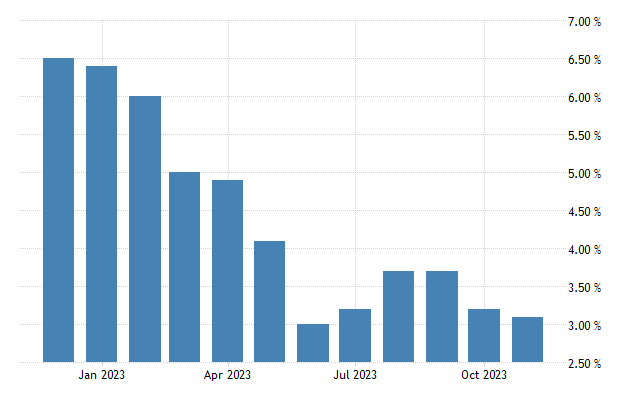
US CPI data
Key highlights from the November CPI report include a 0.2% increase in food prices, with food-at-home prices rising by 0.1% and food-away-from-home (restaurant) prices increasing by 0.4%. Energy prices exhibited mixed trends, and shelter prices experienced a 0.4% climb in November after a 0.3% rise in October. Overall, consumer prices showed modest movements, reflecting a relatively stable economic landscape in November.
US Retail Sales Beats Consensus
In a surprising turn of events, U.S. retail sales defied expectations by increasing 0.3% in November, marking a robust start to the holiday shopping season amid significant discounts. The Commerce Department's Census Bureau reported the rebound, signaling consumer resilience and easing concerns of an imminent recession. This unexpected surge underscores the strong labor market's impact on consumer spending and challenges the financial markets' anticipation of an early 2024 rate cut.
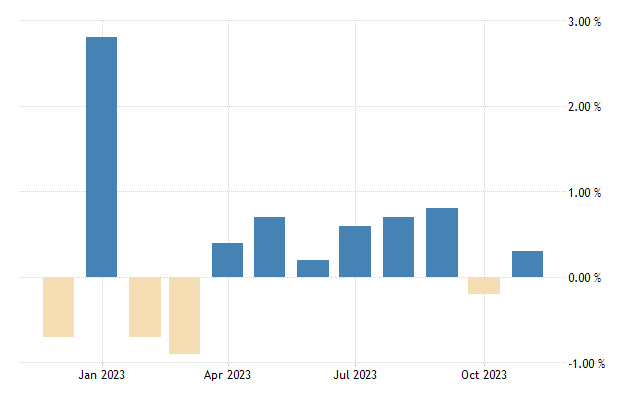
U.S. Retail Sales
The 0.3% rise in retail sales follows a 0.2% dip in October, showcasing the dynamism of consumer spending. Year-on-year, sales increased by 4.1% in November, reflecting a steady pace despite adjustments to higher borrowing costs and prices. Retailers, capitalizing on the holiday season, offered substantial discounts, further boosted by lower gasoline prices, freeing up funds for other expenditures.
Notable increases in online sales, motor vehicles, furniture, and sporting goods underscore a positive trend. Food services also accelerated, indicating strong household finances, but building materials and gasoline station receipts fell, alongside declining gasoline prices.
Core retail sales, excluding specific sectors, rose by 0.4%, reflecting sustained consumer spending momentum. Economists anticipate a potential 2.75% annualized growth in Q4 spending, surpassing previous estimates. However, these positive retail signals contrast with the Federal Reserve's steady interest rates, adding complexity to market expectations. Consumer resilience remains a vital force for economic growth.
Fed Pivots Dovish
Although at TradeDay we have looked for a dovish pivot for some time at the Federal Reserve, Wednesday's somewhat unexpected dovish stance propelled U.S. stocks towards record highs while causing US Treasury yields to plummet. The Fed's decision to hold interest rates steady, signaling the end of a two-year tightening policy, has led to a surge in market optimism, with the S&P 500 experiencing its largest gain since July 2022. The benchmark U.S. 10-year Treasury yield hit its lowest level since late July, standing at approximately 3.96%.
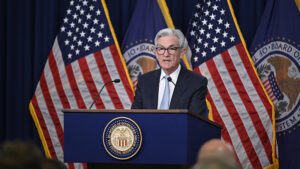
Investors are cheered by the Fed's commitment to lower borrowing costs in 2024, aligning more closely with market expectations. Seventeen out of 19 Fed officials project a lower policy rate by the end of 2024, with the median projection indicating a fall to 4.6% from the current 5.25%-5.50% range. Chair Jerome Powell acknowledged the Federal Reserve's achievement in lowering inflation close to its 2% target, currently standing at 3.1%. He strongly indicated that further interest rate hikes are not anticipated.
Questions linger about how much of the Fed's dovishness has already been factored into a market that has seen a remarkable 22% rise in the S&P 500 this year. Concerns for 2024 include the challenge of maintaining a "Goldilocks" scenario of cooling inflation coupled with resilient growth.
Bank of England and European Central Bank Stay On More Hawkish Path
The European Central Bank remained committed to maintaining tight monetary policies well into the next year, dispelling any optimism that the Federal Reserve's shift toward rate cuts signaled a global shift. Despite the Fed's pivot, the European Central Bank affirmed its hawkish stance during a two-day meeting, explicitly stating that policy easing was not on the table. The Bank of England echoed this sentiment, emphasizing that interest rates would persist at elevated levels for an extended period. Notably, Norway's central bank went a step further by raising rates.
ECB President Christine Lagarde firmly rejected any notion of a pivot, asserting that the central bank had not discussed rate cuts at all. She emphasized a stance of stability, indicating a plateau until more definitive wage data becomes available, likely around spring. The ECB kept interest rates unchanged and indicated an early end to its last remaining bond purchase scheme, impacting the euro's support. Despite this decision, the euro maintained its daily gains, and German 10-year bond yields remained largely unaffected. The ECB's cautious approach aligns with concerns about key economic indicators, such as service inflation and wage growth.
The ECB's economic projections, showing headline inflation at 5.4% in 2023, may hinder aggressive rate cuts next year. Various analysts have suggested that the ECB's dovish shift is likely to be gradual, contrasting with market expectations. The Eurozone faces a challenging economic outlook, prompting debates on the timing of potential rate cuts and highlighting the differences in approach between the ECB and the U.S. Federal Reserve.
The Bank of England has chosen to keep interest rates at a 15-year high of 5.25%, diverging from the more dovish stance of the US Federal Reserve, which unanimously voted to maintain rates between 5.25% and 5.5%. The Bank's Monetary Policy Committee expressed concerns about elevated inflation indicators, suggesting that high rates may need to persist for an extended period.
While three committee members advocated for a rate increase to 5.5%, the majority maintained the current rate, emphasizing the bank's focus on inflation. Despite expectations of future rate cuts, some analysts find the Bank's rhetoric unnecessarily hawkish given economic challenges, including slowing wage growth and a contracting GDP.
The Bank's cautious stance contrasts with the US Federal Reserve's more aggressive tone, hinting at least three rate cuts in the coming year. Economic indicators such as services inflation and wage growth will continue to shape the Bank's future decisions. The pressure from 14 consecutive rate hikes until September has contributed to a 0.3% GDP contraction in October, prompting debates about the Bank's approach to interest rates amid economic challenges.
What's Ahead
Central Bank Watch: A quieter week for Central Banks, we get the Reserve Bank of Australia (RBA) Meeting Minutes and Bank of Japan (BoJ) Monetary Policy decision, statement and conference on Tuesday, then the People's Bank of China (PBoC) Interest Rate Decision Wednesday.
Macro Data Watch: CPI data is released from the EU, Canada and the UK on Tuesday and Wednesday, key data to watch from the US will be Wednesday’s Consumer Confidence release, then Friday brings US PCE (MoM, YoY) and the Michigan Consumer Sentiment Index.
Date
Major Macro Data
12/18/2023
German IFO Survey
12/19/2023
RBA Meeting Minutes; BoJ Monetary Policy decision, statement and conference; EU Harmonized Index of Consumer Prices; Canadian CPI
12/20/2023
PBoC Interest Rate Decision; UK inflation report, including CPI; German Consumer Confidence Survey; US Consumer Confidence; EU Consumer Confidence
12/21/2023
US GDP and PCE (QoQ); Canada Retail Sales
12/22/2023
Japan CPI; UK GDP and Retail Sales; US PCE (MoM, YoY) and Durable Goods; Canada GDP; Michigan Consumer Sentiment Index
.jpg)